Creating a back-to-school routine for kids can make the transition from summer feel more manageable for the whole family. Start by gradually adjusting sleep schedules, organizing school materials, establishing consistent morning habits, and making time for reading, play, and rest.
These five practical steps can help children begin the school year feeling prepared and confident.
1. Start Your Back-to-School Routine for Kids Early
Do not wait until the night before school to return to a school-year schedule. A week or two before the first day, begin gradually adjusting bedtimes, wake-up times, and meal schedules.
The American Academy of Pediatrics notes that predictable family routines, including consistent bedtime rituals, can help children feel secure and settle more easily at night.
Small changes are usually easier than an abrupt shift. Move bedtime and wake-up time earlier in short increments until your child is close to the schedule they will follow during the school year.
Families who have maintained a flexible summer routine for kids can use those familiar anchor habits—such as reading, outdoor time, and a consistent bedtime—as the foundation for the school-year schedule.
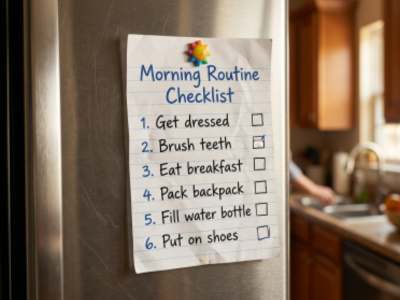
Create a School Morning Routine Chart
Sit down with your child and brainstorm everything that needs to happen before leaving for school.
The list might include:
Getting dressed
Brushing teeth
Eating breakfast
Packing a backpack
Filling a water bottle
Putting on shoes
Turn the list into a checklist using text, pictures, or both, depending on your child’s age. Hang one copy in their room and another near the refrigerator or front door for a final check.
The goal is not to create a perfect morning. It is to reduce last-minute decisions and help children become more independent.
2. Create an Organized Homework and Reading Station
Set up a quiet, comfortable place where your child can read, complete homework, and work on projects. It does not need to be a separate room or even a desk. A section of the kitchen table can work just as well.
Invite your child to personalize the space with their favorite pencils, decorations, folders, artwork, and reading materials. Keeping a favorite magazine or stuffed toy nearby provides a nice break when they finish an assignment or structured task.
Use Color Coding to Organize School Supplies
Ask your child to assign a unique color to each subject. For example, math might be blue, science green, and reading red then use that color consistently for:
Folders
Notebooks
Sticky notes
Calendars
Storage bins
Accordion-file tabs
Digital folders
This at-a-glance system helps children find what they need and makes it easier for parents to confirm that the correct materials are packed each day.
3. Build Reading Into Your Back-to-School Routine
A quick review of skills and concepts from the previous school year can help children enter a new grade with greater confidence. Keep it light and low-pressure. The final days of summer should not feel like an extended school session.
Reading together is one of the easiest ways to help children shift back into a learning mindset. Choose stories and articles that reflect their interests, then ask what surprised them, what they learned, or what they would like to explore next.
Cricket Magazines offer stories, nonfiction, poetry, puzzles, art, and activities for kids from baby through age 12. Whether your child is interested in animals, science, history, art, or imaginative stories, reading about subjects they already enjoy can help learning feel natural rather than assigned.
4. Practice the Back-to-School Routine Before the First Day
Several days before school starts, practice waking up, getting dressed, eating breakfast, packing the backpack, and leaving the house at the appropriate time.
A trial run can help identify forgotten supplies, transportation questions, or parts of the morning that take longer than expected.
You can also practice:
Walking or driving the school route
Going to the bus stop
Filling and closing a water bottle
Organizing their backpack
Timing their bathroom routine
Familiarity can make the first real school morning feel more manageable.Familiarity can make the first real school morning feel more manageable.
5. Make Breaks Part of the Back-to-School Routine for Kids
School routines are important, but children also need time to move, create, relax, and reconnect with their friends and families.
Build outdoor play, hands-on activities, reading for pleasure, and unstructured downtime into the after-school schedule. The CDC recommends that children ages 3 to 5 remain active throughout the day and that children ages 6 to 17 get at least 60 minutes of physical activity each day.
These breaks can help children decompress before beginning homework or preparing for the next day.
A Cricket magazine, favorite story, or short Sensical video can also provide a calm transition between school and evening activities. Let children choose something connected to their interests rather than turning every activity into another assignment.
How Long Does It Take to Establish a Back-to-School Routine?
Many families begin adjusting their schedules one to two weeks before school starts. The exact timing depends on how different the summer and school-year routines are.
Consistency matters more than making every change at once. Gradually introduce the routine, observe what is working, and adjust it to fit your family.
Final Thoughts
A successful back-to-school routine for kids should make room not only for schoolwork, but also for curiosity, imagination, and reading for enjoyment.
Cricket Media Magazines help children continue exploring at home with engaging stories, articles, puzzles, art, and activities created for every stage of childhood—from BABYBUG® for infants and toddlers to CRICKET® for curious readers ages 9 to 12.
Begin one to two weeks before school starts. Gradually adjust bedtime, wake-up time, meals, and morning habits rather than changing everything the night before.
Make a short checklist of everything your child needs to do before leaving. Use words, pictures, or both, and display the checklist where your child can easily follow it.
There is no single required amount. A consistent reading habit that feels enjoyable and appropriate for the child is more valuable than forcing a specific number of minutes.
Your privacy matters to us. We use cookies and similar technologies to help our website function properly, improve your experience, and better understand how visitors use our site. We only collect and use information in accordance with our Privacy Policy and are committed to protecting your data.
You are always in control of your choices. You can choose to accept or decline these technologies, and you may change your preferences at any time. Please note that if you choose not to allow certain technologies, some features of the site may not function as intended.
Functional
Always active
The technical storage or access is strictly necessary for the legitimate purpose of enabling the use of a specific service explicitly requested by the subscriber or user, or for the sole purpose of carrying out the transmission of a communication over an electronic communications network.
Preferences
The technical storage or access is necessary for the legitimate purpose of storing preferences that are not requested by the subscriber or user.
Statistics
The technical storage or access that is used exclusively for statistical purposes.The technical storage or access that is used exclusively for anonymous statistical purposes. Without a subpoena, voluntary compliance on the part of your Internet Service Provider, or additional records from a third party, information stored or retrieved for this purpose alone cannot usually be used to identify you.
Marketing
The technical storage or access is required to create user profiles to send advertising, or to track the user on a website or across several websites for similar marketing purposes.