
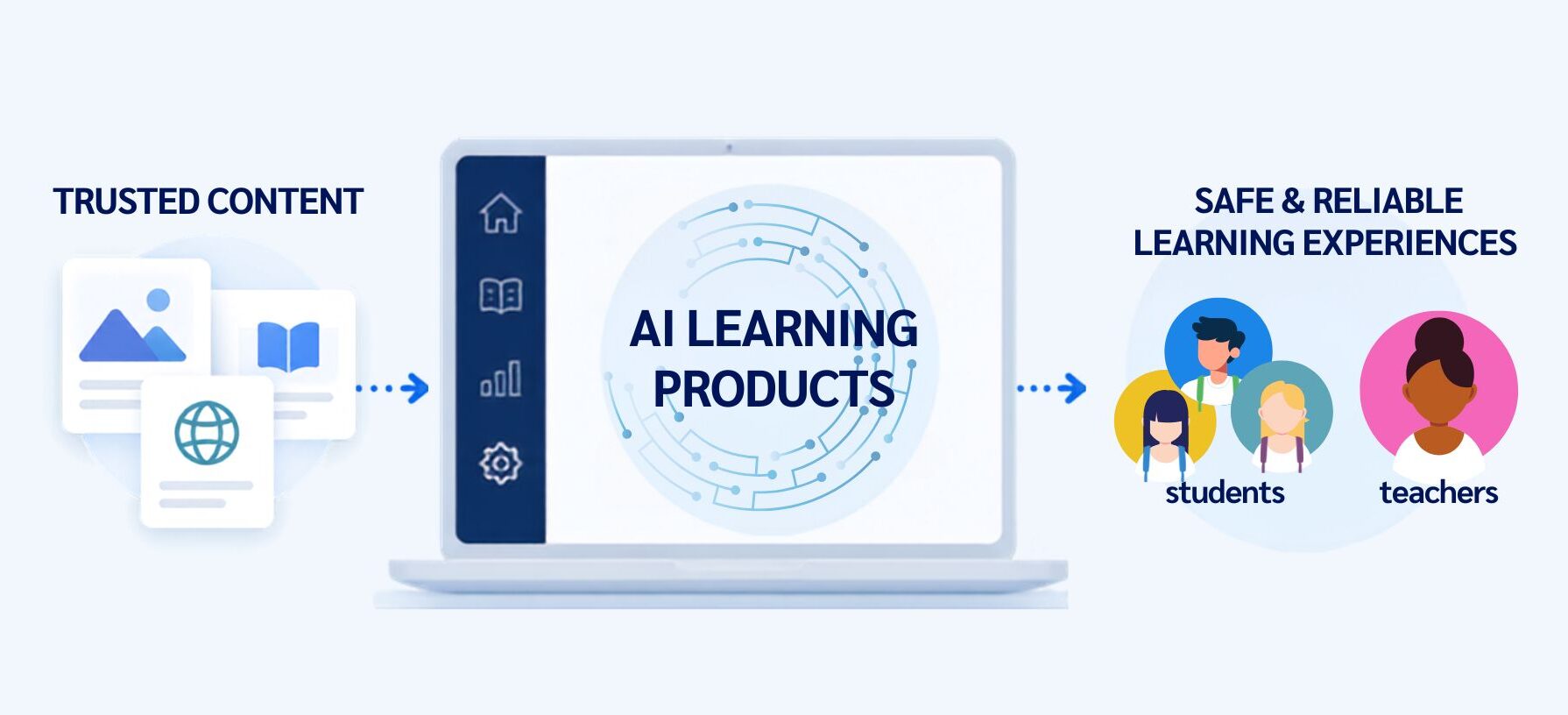
For decades, educational content licensing served a clear purpose. Publishers, assessment providers, curriculum developers, and edtech companies licensed articles, stories, videos and passages to fill gaps, support instruction, and engage learners.
AI is changing that role. But it must be approached deliberately, and access to trusted, verifiable content to power AI applications must be one of the building blocks
Education leaders are already being asked to evaluate how AI can support teaching and learning while protecting students, preserving trust, and improving learning experiences.
The organizations best positioned for the future will not simply be those with the largest AI models. They will be those with access to trusted, rights-cleared, age-appropriate content that can serve as the foundation for safe and reliable learning experiences.
What Is Trusted Content for AI Learning Products?
Trusted content for AI learning products is content that is accurate, rights-cleared, age-appropriate, editorially reviewed, and supported by clear metadata. It gives AI systems a safer foundation for retrieving information, generating responses, recommending resources, and supporting learning pathways.
In education, this distinction matters. AI-powered learning tools do not just need more content. They need content that educators, families, and product teams can trust.
Content Is Becoming Strategic Infrastructure
Historically, educational companies licensed content to support specific product use cases.
An article might appear in a reading program. A nonfiction passage might be used in an assessment. A video might supplement a science or social studies lesson.
Today, a single piece of content can support multiple functions simultaneously:
- Content retrieval and discovery
- Recommendations for educators, students and internal teams
- Source-verified AI-generated responses
- Personalization learning pathways
- Explainable student and teacher experiences
Content is no longer simply a product component. For AI-powered learning products, content is infrastructure.
Why AI Learning Products Need Trusted Sources
The acceleration of generative AI creates new opportunities for educational products but it also raises important trust questions.
UNESCO’s guidance on generative AI in education emphasizes that education systems need deliberate policies and human-centered approaches.
Educators, administrators, and parents need to know:
- Where did this answer come from?
- Is the information accurate?
- Is it age appropriate?
- Can the source be verified?
- Is the content aligned to educational goals?
- Can the system explain or cite its sources?
Open web content is difficult to rely on in educational settings because the information may be inaccurate, outdated, biased, inappropriate, or hard to verify. That does not mean all third-party content should be avoided. It means AI learning products need bounded, verifiable, and rights-cleared content sources that greater transparency, safety, and instructional integrity.
Trusted third-party content can also add breadth, flexibility and diversity to the experiences without sending students into the open internet.
What Makes Content AI ready?
The rise of AI has created a new distinction between content that is merely available and content that truly AI-ready.
AI-ready content typically includes:
- Rights clarity: Clear permissions for retrieval, summarization, recommendation, and AI-grounded responses.
- Editorial quality: Reviewed, fact-checked and vetted for educational use
- Source diversity: Human-created work from a range of authors, subjects, formats, and perspectives
- Age appropriateness: Alignment by age band, reading level, and developmental stage.
- Rich Metadata: Topic, Lexile/reading level, media type, source, author, publication date, rights terms, and usage permissions
- Breadth and depth: A large, varied collection that supports meaningful exploration across student interests and academic subjects.
These characteristics are becoming increasingly important as organizations use content in applications for internal users, for educators and for students.
Questions to Ask Before Building AI Learning Products
As AI becomes more embedded in learning products, education leaders should ask:
- What content powers our AI experiences?
- Can we explain where AI-generated answers come from?
- Are our sources trusted by educators and families?
- Can we verify, audit and improved responses over time?
- Is the content appropriate for the students we serve?
- Do we have the rights to use this content in AI-powered applications?
- How will we maintain quality and safety as AI capabilities expand?
Organizations that can answer these questions clearly and confidently will be better positioned to use AI responsibly and build products that educators and families can trust. These questions align with a broader need to manage AI risks in ways that account for individuals, organizations, and society.
Cricket Media’s growing library of rights-cleared articles, videos, and educational resources has been built for learning, supported by rich metadata, and backed by decades of editorial excellence. For organizations developing AI-powered learning products, Cricket content can provide the trusted foundation needed to build safer, more reliable, and engaging educational experiences.
See How Cricket Media Content Can Support Your AI-Powered Learning Products.
Schedule a demo to check out Cricket’s Licensing Library ⬇️
